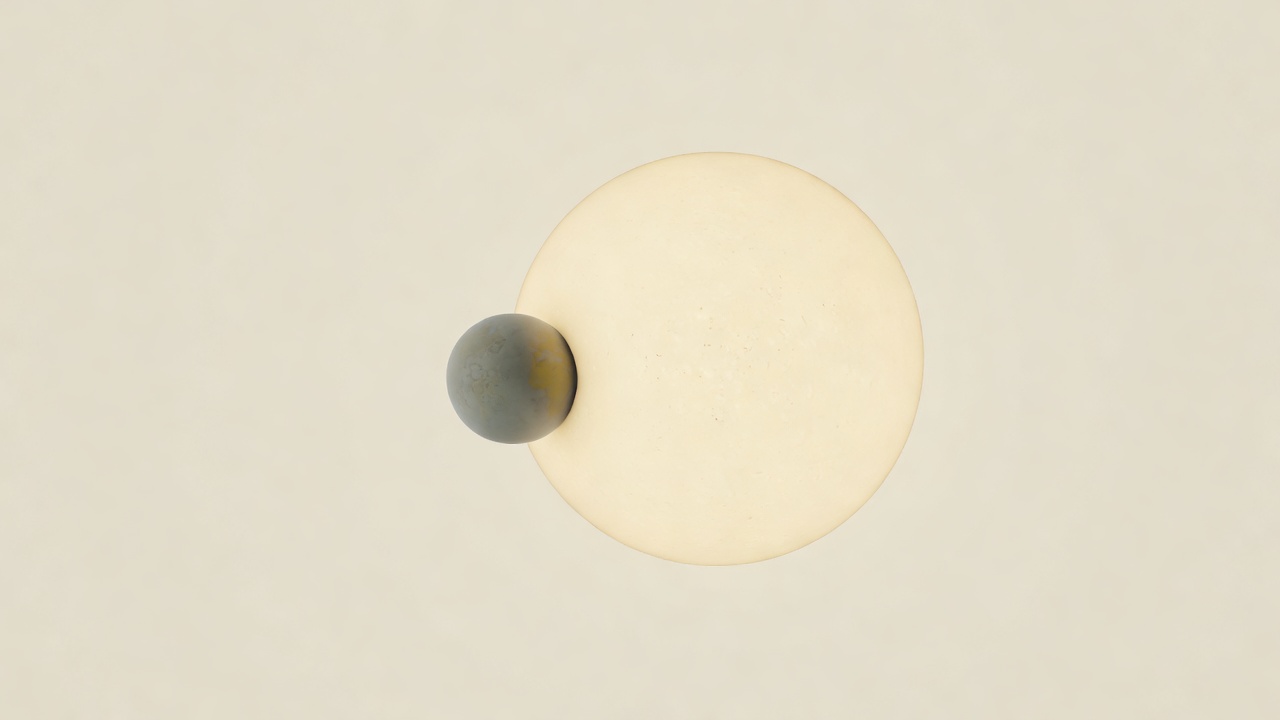
Predict what happens to the light
Imagine watching a distant lamp while a small object crosses in front of it. You may not resolve the object, yet the total light reaching you decreases slightly. A planet crossing its star can produce a comparable pattern, called a transit. Before reading further, predict which would usually block more light: a larger planet or a smaller one crossing the same star.
For a simple transit, the fractional dimming is approximately the planet’s projected area divided by the star’s projected area. That makes the radius ratio important. Real measurements must also account for the star’s uneven apparent brightness, instrumental behavior and possible contamination by other stars. The first dip is a clue, not an automatic announcement of a new world.
Repetition strengthens the case
A planet in a stable orbit can produce repeating transits with a consistent spacing. NASA’s Kepler mission searched for these small changes across many stars. TESS, the Transiting Exoplanet Survey Satellite, uses the same basic technique while surveying large portions of the sky. Astronomers examine the shape, timing and consistency of each candidate signal.
Other processes can imitate a transit. A pair of eclipsing stars, blended with another star’s light, may produce a deceptively shallow dip. Instrumental artifacts can also complicate the record. Follow-up observations and statistical validation help distinguish explanations. “Candidate” and “confirmed planet” therefore communicate different levels of evidence rather than merely different degrees of excitement.
A star can move, too
A star and its planet orbit a common center of mass. As the star moves toward and away from us, features in its spectrum shift because of the Doppler effect. This radial-velocity method can reveal an orbiting companion without directly photographing it. The size and timing of the stellar motion constrain the companion’s properties.
A transit can estimate a planet’s size relative to its star. Radial velocity constrains its mass, with a dependence on orbital orientation. When suitable observations combine, astronomers can estimate bulk density. Density helps distinguish broadly rocky worlds from lower-density planets, but it does not reveal a unique interior blueprint. Different mixtures of materials can sometimes fit similar measurements.
Distance also means delay
Light travels at a finite speed. Sunlight takes about eight minutes and twenty seconds to reach Earth, with a small variation as Earth’s distance changes through its orbit. A light-year is the distance light travels in one year in vacuum. It is not a unit for how old a star is, although receiving distant light inevitably means seeing an earlier state.
For very distant galaxies, cosmic expansion makes distance language more complicated. Light-travel time and present-day distance are not interchangeable labels. You do not need advanced mathematics to spot the basic issue: the universe can change while light is on its way. A careful article says which distance concept it is using instead of treating every large number as the same measurement.
What “potentially habitable” does not establish
A planet in a star’s habitable zone receives an amount of energy that could allow liquid surface water under suitable atmospheric conditions. That is not a report of oceans, organisms or comfortable weather. Atmospheric composition, pressure, clouds, stellar activity and the planet’s history all matter. A useful prediction must survive these additional questions.
The James Webb Space Telescope can study some exoplanet atmospheres by measuring how light varies with wavelength. Those observations are demanding, and possible molecular signals depend on analysis and atmospheric models. A claimed detection should be read alongside its uncertainty, alternative explanations and independent checks. Attractive illustrations of alien landscapes are interpretations, not photographs of discovered coastlines.
Can we do a safe transit demonstration at home?
Use a large paper circle as a star and a smaller paper circle as a planet. Move the small circle across the large one and compare covered areas. This demonstrates geometry, not a calibrated light measurement. Never look at the Sun through binoculars or a telescope without appropriate specialist solar equipment and expertise.