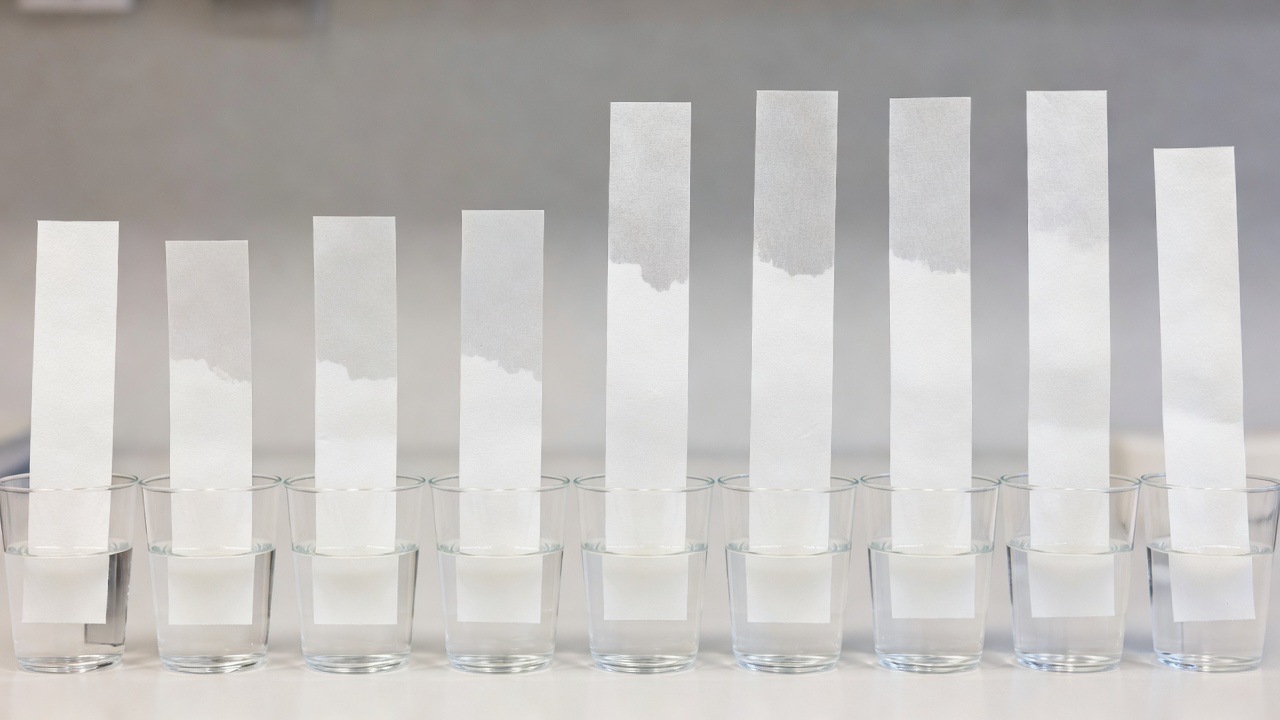
Notice, then commit to a prediction
A towel absorbs a spill so quickly that the movement can seem obvious. Slow it down. Cut a strip, lower one end into water and watch the boundary between wet and dry paper. Before starting, predict whether that boundary will stay level with the water, rise a little or climb most of the strip. Write down a reason as well as an answer.
A prediction is not a promise to be right. It makes your current explanation visible. If you think heavier paper must absorb more quickly, say so before comparing it with thinner paper. Otherwise, it is easy to remember that you “expected” whichever result appears. A dated note, a simple sketch and a few measurements help resist that very human habit.
Set up a small investigation
You need two similar cups, water, two paper strips, a ruler, a pencil and a timer. A tray is useful for spills. Stand each strip so that its lower end dips into the water and its upper part remains outside the cup. Support it without squeezing the wetted section. Keep the starting immersion depth equal and avoid letting a strip rest flat against the cup wall.
- Mark a starting waterline on a separate reference sheet beside each strip.
- Start both trials together and note the wet-front height after one, three and five minutes.
- Describe the boundary if it is uneven rather than pretending it has a perfectly sharp edge.
- Repeat with fresh, dry strips. Compare the repeated results, not just the most impressive trial.
What moves the water?
Paper contains a network of cellulose fibers and small connected spaces. Water interacts with the fibers through adhesion, while cohesion describes attraction among water molecules. Surface tension and the geometry of the wetted spaces contribute to capillary pressure. Together, these effects can move water through paper even against gravity. The towel is not generating an unlimited upward force.
The familiar phrase “water sticks to paper” is a useful beginning, but not a complete mechanism. Pore sizes, surface chemistry and the structure of the fiber network matter. Gravity opposes the rise; evaporation can also change the pattern. In a real towel, many irregular pathways act together. That is why a neat textbook drawing of one thin tube is a model, not a literal picture of the whole material.
Change one useful thing
For a first comparison, change paper type while keeping strip width, exposed length, water depth, timing and room conditions as similar as practical. This does not make two commercial towels identical except for one microscopic feature. It does make the comparison easier to interpret. If you change the strip width and paper type together, you cannot confidently assign a difference to either change alone.
Keep absorption speed separate from total capacity. A strip that becomes wet quickly does not necessarily hold the largest amount of water. Measuring capacity would require a different procedure, such as comparing masses before and after wetting under a consistent draining method. Avoid claiming that one brief test identifies the “best” towel for every household job.
What if the water barely moves?
Check that the strip is genuinely touching water and was dry at the start. Some papers are coated or treated to resist wetting. A small movement is still evidence; do not quietly replace an unhelpful result with an expected one.
Make the explanation earn its place
Ask what else your explanation predicts. Would a water-resistant sheet behave like absorbent paper? Would a wider strip necessarily rise higher? These questions separate a mechanism from a memorized label. “Capillary action” names a family of effects; an explanation should connect those effects to what you measured.
Plants also move water, but a tree is not just a giant paper towel. Evaporation from leaves, water transport through xylem and tension in connected water columns are central to the larger story. A kitchen experiment can introduce surface forces without proving that every water-transport system works in exactly the same way. Good science often begins with a small analogy and improves when we notice its limits.