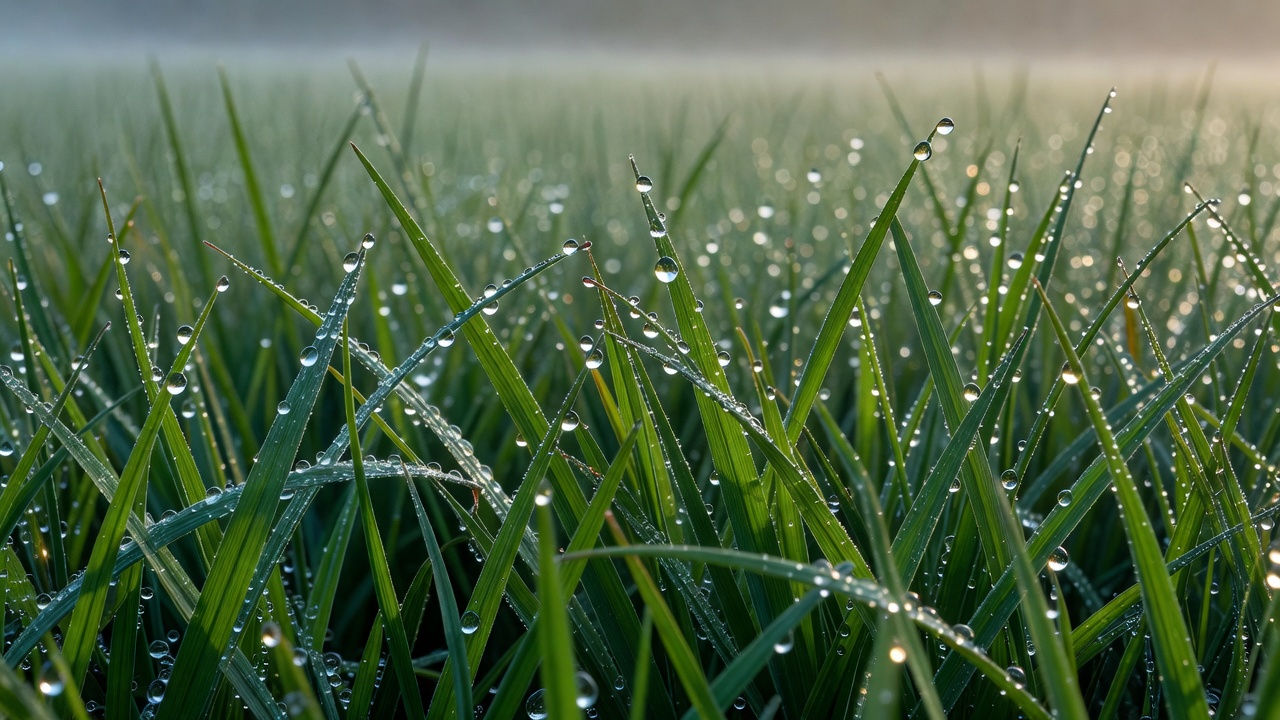
Start with a morning mystery
The garden is wet, but the overnight rain gauge is empty. Predict where the water came from before deciding the gauge must be wrong. Air contains water vapor, an invisible gas. A surface that becomes cool enough can cause water vapor nearby to condense into droplets. Dew can therefore appear without droplets falling from a cloud.
On a clear night, an exposed surface can lose energy by emitting thermal radiation toward the sky. Grass, roofs and car windows may cool differently from the surrounding air and from sheltered objects. If a surface cools to the local dew point, condensation becomes possible. The details depend on moisture, wind, cloud cover and the surface’s energy balance.
The dew point is a useful comparison
The dew point is the temperature to which air must be cooled, under specified conditions, to reach saturation with respect to water. Relative humidity expresses how close the air is to saturation at its current temperature. The same amount of water vapor can correspond to different relative humidities as temperature changes. This is why a humidity percentage needs temperature context.
People often say warm air “holds more water.” That phrase is convenient but can mislead: air is not a sponge with tiny storage pockets. The saturation vapor pressure of water increases with temperature. Thinking in terms of evaporation, condensation and equilibrium gives a better foundation than imagining that cold air simply squeezes liquid out.
Follow a puddle as it disappears
Now consider a small puddle after rain. It can disappear without boiling because evaporation happens at ordinary temperatures. Molecules continually exchange between liquid water and surrounding air. When more leave than return, the liquid shrinks. Sunlight can supply energy, while moving air can replace humid air near the surface with drier air.
Predict which of two similar damp cloths will dry faster: one spread out or one folded tightly. Increasing the exposed area usually helps evaporation, but temperature, humidity and airflow also matter. Do not compare a sunny windowsill with a cold cupboard and then attribute the entire difference to folding. A fair comparison changes one useful factor at a time.
Clouds are not visible water vapor
Water vapor itself is invisible. Most familiar clouds become visible because they contain many tiny liquid droplets, ice crystals or both. Air rising through the atmosphere often expands as pressure decreases and cools. Under suitable conditions, water condenses onto small particles, creating droplets that scatter light. This explanation connects motion, pressure, temperature and moisture rather than treating a cloud as a floating bag of steam.
Droplets do not need to be weightless to remain in a cloud. Small particles fall slowly relative to the surrounding air, and atmospheric motions can help maintain the cloud. Rain formation involves droplets or ice particles growing sufficiently to fall through the air. Not every cloud develops the same internal processes, and not every dark cloud produces rain at your location.
Can one cloud tell me tomorrow’s weather?
A cloud can offer a clue, but a reliable forecast combines many observations and a model of the atmosphere. Use your notes to learn patterns, not to replace official forecasts or warnings.
A rainbow depends on where you stand
Sunlight entering a water droplet changes direction through refraction. Some light reflects inside the droplet and refracts again as it leaves. Different wavelengths follow slightly different paths, separating the colors. The primary rainbow is seen in directions roughly 42 degrees from the point directly opposite the Sun, with the exact angle varying across colors.
That geometry means a rainbow is not an object sitting at one fixed place in a field. Move, and a different set of droplets can send the relevant light to your eyes. Two observers can admire what seems like the same arc while receiving light from different droplets. With the Sun behind you, look toward rain ahead—but never compromise road safety or storm shelter to do so.
Keep an honest weather notebook
Record time, location, shelter, cloud cover and what you actually saw. Separate “the grass was wet” from “dew formed overnight”; the first is an observation, the second an interpretation. Repeated observations can test that interpretation. Your notebook becomes more useful when it preserves uncertainty instead of turning every coincidence into a rule.