Predict what a useful invention needs
Imagine designing a new lamp. Making it glow once is an achievement, but would that be enough for a household? You would also care about lifetime, cost, repair, electricity supply and safe use. Predict which of these obstacles would be hardest to solve. This simple exercise reveals why invention histories rarely fit inside a sentence about one brilliant moment.
Historical credit depends on the question being asked. An early demonstration may establish priority for a principle. A patent may document a particular claim. A commercial product may show that a team solved manufacturing problems. Widespread adoption may depend on infrastructure and social decisions. None of these records automatically replaces the others, and a patent alone does not prove the first appearance of every related idea.
Printing existed before Gutenberg
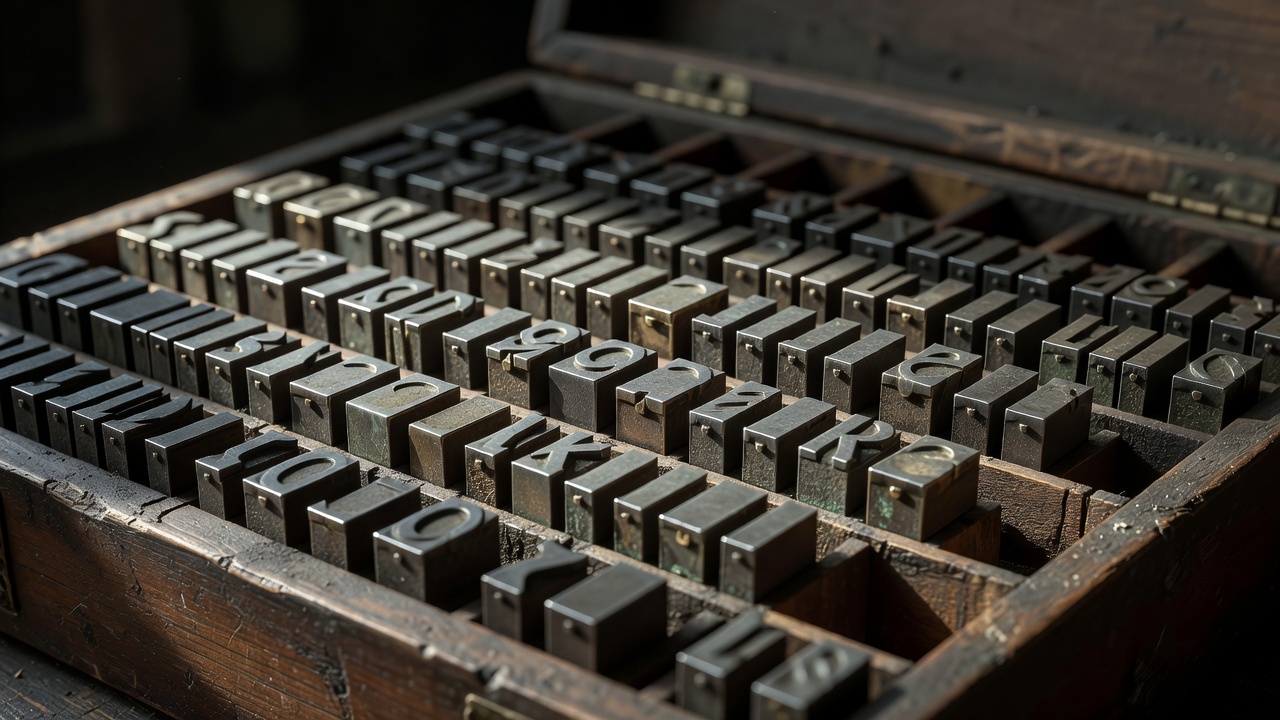
Johannes Gutenberg is central to the development of movable-metal-type printing in fifteenth-century Europe. That does not mean printing began with him. Woodblock printing had a much longer history in East Asia. Bi Sheng developed an early movable-type method in China in the eleventh century, using ceramic characters. Korean printers also used movable metal type before Gutenberg’s European work.
The surviving Jikji, printed in Korea in 1377, is widely recognized as the oldest surviving book printed with movable metal type. Its survival is evidence of a technology already in use, not proof that nobody ever attempted an earlier version. Notice the difference between “oldest surviving example” and “first object ever made.” Archaeology and document preservation make that distinction essential.
Gutenberg’s achievement involved a workable combination: type production, suitable ink, a press and an organized printing process. The mechanism matters because reusable letters can be rearranged for another page. The system matters because preparing type, applying ink and producing consistent impressions must work together. A label such as “inventor of printing” erases more history than it explains.
The electric lamp needed a network
Thomas Edison and Joseph Swan are important figures in the development of practical incandescent lighting. They worked within a longer history of experiments with electrically heated materials. An incandescent filament emits light because it becomes hot; controlling the environment around it helps prevent rapid destruction. Material selection, electrical resistance and manufacturing consistency all affect usefulness.
Edison’s work is also associated with developing an integrated lighting system, including generation and distribution. A durable lamp is more valuable when power can reach customers reliably. This does not make every contribution to electric lighting Edison’s invention. It shows why historians distinguish a component from the infrastructure surrounding it. Today’s LED lamps use a different light-producing mechanism and should not be described as tiny incandescent bulbs.
A fastener borrowed a useful structure
George de Mestral developed the hook-and-loop fastener after studying how burrs attached to clothing and animal fur. The widely retold story is useful because the connection between natural structure and engineered mechanism can be examined. Tiny hooks catch loops; pulling the two surfaces apart disengages many small connections. The product still required material choices and manufacturing development.
The brand name VELCRO is often used casually for any such fastener, but hook-and-loop is the generic description. That distinction separates a technical mechanism from a trademark. You can inspect a clean, loose sample with a magnifying glass and predict which side contains hooks. Keep small samples away from young children, and do not collect irritating plant burrs for the activity.
Build a better fact collection
For each claim, record the object, the specific achievement, the evidence and any limitation. “Gutenberg developed an influential European printing system” is more informative than “Gutenberg invented all printing.” “A surviving example dates to 1377” is more defensible than claiming certainty about an unknowable first attempt. Better wording does not make history less interesting; it reveals the actual work.
Use museums, libraries, patents and historical scholarship together. Museum labels summarize; patents define legal claims; advertisements promote; later recollections can simplify. Comparing these records turns a collection of surprising facts into an investigation of how knowledge is preserved and credited. The most useful final question is often: whose contribution disappears when we make the story shorter?